
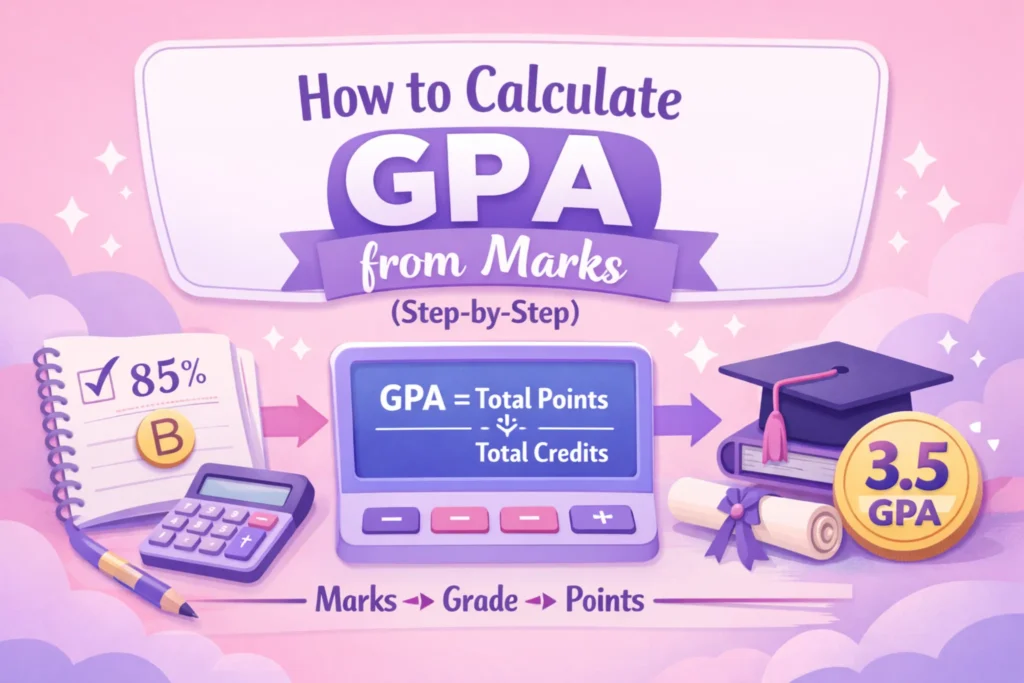
How to Calculate GPA from Marks
Many students feel stuck when trying to convert their marks into GPA. Marks are easy to understand, but GPA feels confusing. Different websites show different answers, so it becomes hard to trust the result. Because of this, students often worry about using the wrong method. Calculate GPA here: GPA Calculators
In my experience, this problem comes up a lot, especially with students applying to US colleges. Most of them have good marks but do not know how to convert them correctly. However, once they follow a clear method, the process becomes simple and accurate. Calculate your CGPA here.
Quick Answer
To calculate GPA from marks, convert your percentage into a letter grade, assign GPA points, multiply by credit hours, and divide total points by total credits.
What Is GPA?
GPA stands for Grade Point Average. It shows your academic performance using a number scale. In most US schools, the 4.0 scale is used.
For example:
Sometimes, schools also use plus and minus grades. Therefore, GPA can vary slightly.
Important Note About GPA Conversion
Before learning how to calculate GPA from marks (step-by-step), it is important to understand one key point. GPA systems are not exactly the same in every school. In some cases, schools use detailed grading scales, while others use simpler ones.
So, the table below gives a general estimate. Although it works for most US systems, small differences may exist.
Percentage to GPA Conversion Table
| Marks (%) | Grade | GPA |
|---|---|---|
| 93–100 | A | 4.0 |
| 90–92 | A- | 3.7 |
| 87–89 | B+ | 3.3 |
| 83–86 | B | 3.0 |
| 80–82 | B- | 2.7 |
| 77–79 | C+ | 2.3 |
| 73–76 | C | 2.0 |
| 70–72 | C- | 1.7 |
| 67–69 | D+ | 1.3 |
| 65–66 | D | 1.0 |
| Below 65 | F | 0.0 |
As a result, this table helps you convert marks into GPA points clearly.
Step-by-Step: How to Calculate GPA from Marks
Now let’s go through how to calculate GPA from marks (step-by-step) in a simple way.
First, match your marks with the table. For instance, 85% becomes B, while 91% becomes A-. This step is quick and easy.
Next, assign GPA values. For example, B = 3.0 and A- = 3.7. At this stage, each subject has a GPA value.
After that, multiply GPA points by credit hours. Credit hours show how important a subject is.
For example:
| Subject | GPA | Credits | Points |
|---|---|---|---|
| Math | 3.0 | 4 | 12 |
| English | 3.7 | 3 | 11.1 |
Then, add everything together.
Total Points = 12 + 11.1 = 23.1
Total Credits = 4 + 3 = 7
Finally, divide total points by total credits.
GPA = 23.1 ÷ 7 = 3.30
In this way, you get your final GPA.
Complete Example
Let’s apply how to calculate GPA from marks (step-by-step) in one full example.
Marks:
Math: 88% → B+ → 3.3 (4 credits) English: 91% → A- → 3.7 (3 credits)
Calculation:
Math = 3.3 × 4 = 13.2 English = 3.7 × 3 = 11.1
Total Points = 24.3 Total Credits = 7
GPA = 24.3 ÷ 7 = 3.47
As you can see, the method works clearly.
Why Credit Hours Matter
Many students ignore credit hours. However, they play a big role in GPA calculation.
A subject with more credits affects GPA more. Therefore, GPA is not a simple average. Instead, it is a weighted result based on subject importance.
Weighted GPA (Quick Note)
In some schools, advanced courses give extra points. For example, an A in an advanced class may be 5.0 instead of 4.0.
So, always check your school’s system before calculating.
Can All Marks Be Converted to GPA?
Not always. Some grading systems are different.
For example:
Some countries use a 10-point scale Some schools do not use percentages
In such cases, direct conversion may not be exact.
Estimate Your GPA
Sometimes, a quick estimate is enough.
For example:
80–90% usually gives GPA between 2.7 and 3.7
This helps you plan your academic goals.
Common Mistakes to Avoid
While learning how to calculate GPA from marks (step-by-step), avoid these mistakes:
Averaging percentages directly Ignoring credit hours Using the wrong GPA scale Assuming all schools use the same system
Because of these mistakes, results can be incorrect.
Conclusion
From what I have seen, students often think GPA is difficult. In reality, the process becomes simple once the steps are clear. Many mistakes happen because of confusion about credit hours or grading scales.
If you follow the method explained here, your GPA calculation will be much more accurate. This approach is based on common US grading systems, so it gives a reliable estimate. Even then, checking your school’s official policy is always a smart step.