
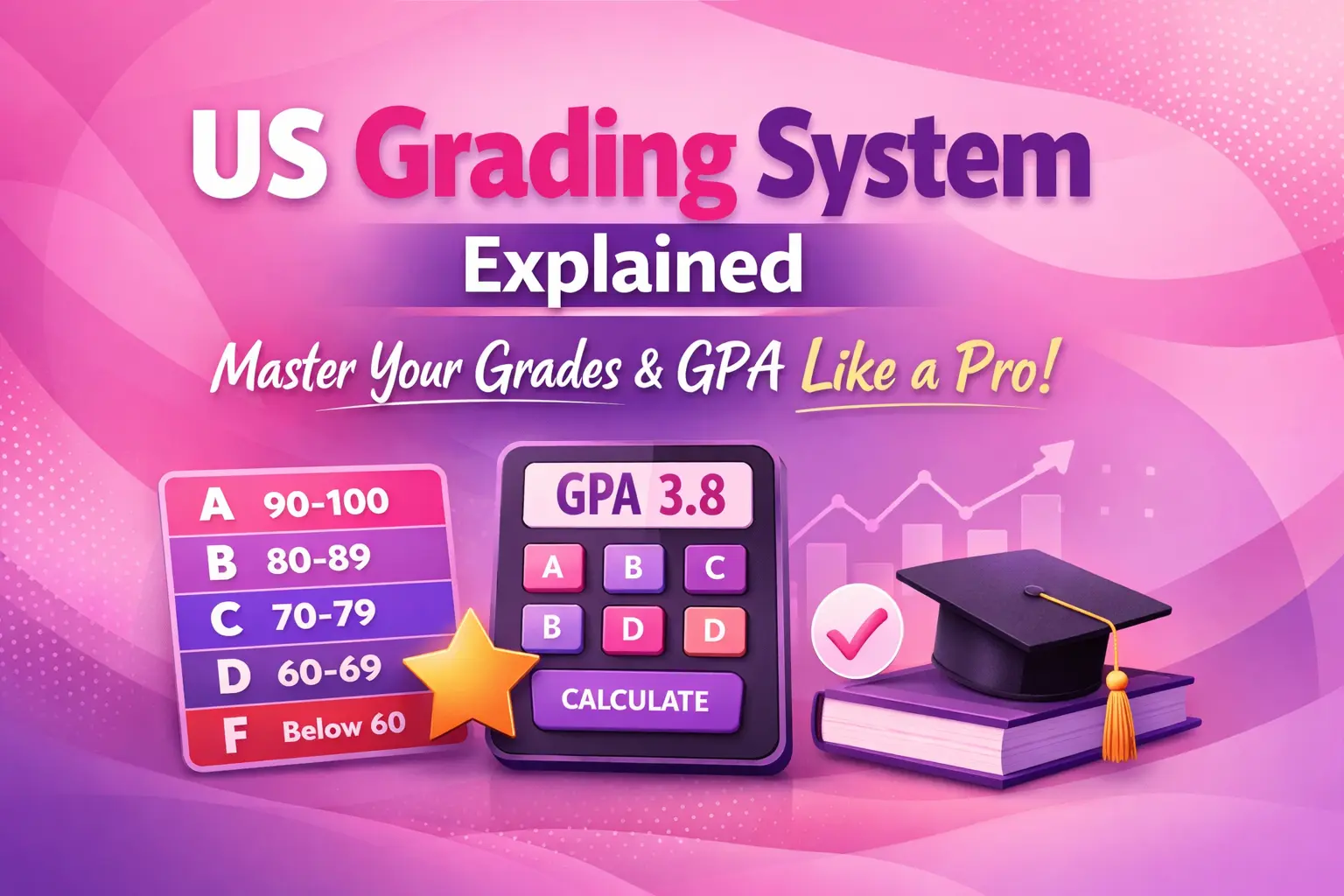
US Grading System Explained (A–F, GPA Scale & Percentages)
Many students struggle with the US grading system because it does not rely on percentages alone. A score that looks strong in one country may translate into an average GPA in the United States. This creates confusion during admissions, scholarship reviews, and academic evaluations.
The problem gets worse when students guess their GPA or rely on incorrect charts found online. A small misunderstanding can affect applications, eligibility, and academic planning.
This guide fixes that. Below is a clear, verified explanation of the US grading system, how percentages convert into letter grades, how GPA is calculated, and why it matters.

How the US Grading System Works?
The US grading system uses three connected measurement methods:
Percentages are used for exams and coursework. Letter grades summarize performance. GPA averages results across subjects and semesters.
Colleges and universities focus mainly on GPA, not individual percentages.
Letter Grades Used in the US
A–F Letter Scale
| Letter Grade | Meaning |
|---|---|
| A | Excellent |
| B | Good |
| C | Average |
| D | Below average |
| F | Fail |
Some schools use plus and minus grades such as A- or B+. Others do not. Both systems are accepted in the US grading system.
US Grading System Percentage Chart
Percentage to Letter Grade Conversion
| Percentage Range | Letter Grade |
|---|---|
| 90–100 | A |
| 80–89 | B |
| 70–79 | C |
| 60–69 | D |
| Below 60 | F |
Most US schools follow these ranges. Individual institutions may shift cutoffs slightly, but the structure remains consistent.
GPA Scale in the US (4.0 Scale)
Letter Grade to GPA Values
| Letter Grade | GPA Value |
|---|---|
| A | 4.0 |
| B | 3.0 |
| C | 2.0 |
| D | 1.0 |
| F | 0.0 |
Each course contributes GPA points. Final GPA is calculated by averaging these values, often weighted by credit hours.
→ Check your GPA here: All GPA Calculators. Read also: How GPA is calculated( formula + Example)
How GPA Is Calculated
Step-by-Step Example
| Subject | Letter Grade | GPA |
|---|---|---|
| Math | A | 4.0 |
| English | B | 3.0 |
| Science | B | 3.0 |
| History | C | 2.0 |
This is the standard calculation method used across the US grading system.
Weighted vs Unweighted GPA
Unweighted GPA
Weighted GPA
High schools often report both values. Colleges review GPA together with course difficulty.
→ Read about: Weighted GPA vs Unweighted GPA
US Grading System for International Students
The US grading system converts international grades into GPA for fair comparison.
Common cases include:
Most universities follow evaluation practices aligned with official credential assessment agencies.
What Is a Good GPA in the US?
| GPA Range | Academic Standing |
|---|---|
| 3.7–4.0 | Excellent |
| 3.0–3.6 | Good |
| 2.5–2.9 | Average |
| Below 2.5 | Weak |
Many scholarships require a minimum GPA of 3.0. Competitive universities often expect 3.5 or higher.
Is a D a Passing Grade?
In many institutions, a D is technically passing.
However:
School policies vary, so students must check official guidelines.
Why GPA Matters More Than Percentages
Percentages reflect performance in one subject.
GPA reflects long-term academic consistency.
Because of this, GPA is used for:
This is why students rely on GPA and grade calculators instead of manual estimates.
Use Grade Calculator (EZ grader) or this Percentage Calculator to make your calculation easier.
Final Notes
The US grading system follows defined rules. Once letter grades, percentages, and GPA are understood, academic planning becomes accurate and predictable.
Using verified charts, correct formulas, and trusted calculators prevents mistakes that can affect admissions and scholarships.