
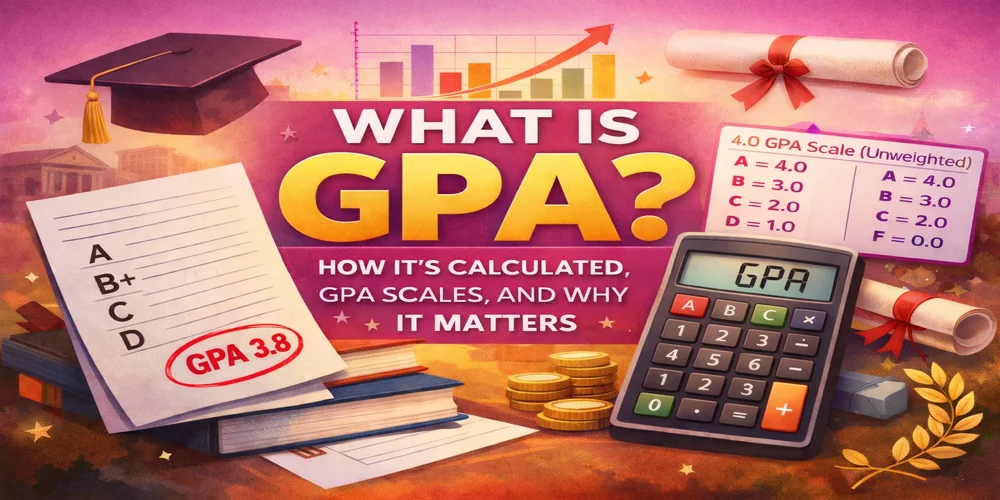
What Is GPA? How It’s Calculated, GPA Scales, and Why It Matters
Many students see GPA on report cards, college applications, and scholarship forms but are unsure what it actually represents. Some know it’s important, yet don’t understand how it’s calculated or how different GPA scales work. This confusion often leads to incorrect calculations and poor academic decisions.
The problem is that most GPA explanations are either too shallow or too technical. Some sites define GPA without showing how it’s calculated. Others offer calculators without explaining what the results mean. This leaves students with numbers they don’t fully trust.
If GPA isn’t clearly understood, it can affect college admissions, scholarships, and academic planning. Not knowing how GPA works also makes it harder to improve it or set realistic goals.
This guide solves that problem by clearly explaining what GPA is, how it’s calculated, how GPA scales work, and why GPA matters, with simple examples and practical context.
What Is GPA?
GPA stands for Grade Point Average. It is a numerical representation of a student’s average academic performance over a semester, academic year, or entire program.
Schools and universities calculate GPA by converting grades (such as A, B, or percentages) into grade points and averaging them based on credit hours or course units. GPA provides a standardized way to measure academic achievement across different courses and terms.
If you want to calculate your score instantly, you can use a GPA Calculator here to avoid manual errors and save time.
Full Form of GPA
GPA = Grade Point Average

How Is GPA Calculated?
GPA calculation is based on three elements:
GPA Formula
GPA = Total Grade Points ÷ Total Credit Hours
Example GPA Calculation
| Course | Grade | Grade Points | Credits |
|---|---|---|---|
| Math | A | 4.0 | 3 |
| English | B | 3.0 | 3 |
| Science | A- | 3.7 | 4 |
Total grade points = (4.0×3) + (3.0×3) + (3.7×4) = 35.8 Total credits = 10
Semester GPA = 3.58
For long-term academic tracking across multiple semesters, this average is combined into what’s known as Cumulative GPA (CGPA), which you can calculate using a dedicated CGPA Calculator.
GPA Scale Explained
Different institutions use different GPA scales. The two most common are unweighted and weighted scales.
4.0 GPA Scale (Unweighted)
4.0 GPA Scale
A = 4.0
B = 3.0
C = 2.0
D = 1.0
F = 0.0
All courses are treated equally, regardless of difficulty.
5.0 GPA Scale (Weighted)
Weighted GPA accounts for course difficulty. Advanced classes such as Honors, AP, or IB may carry extra points.
This helps universities understand both performance and academic rigor.
Weighted GPA vs Unweighted GPA
An unweighted GPA measures grades only and typically uses the 4.0 scale.
A weighted GPA includes course difficulty and may extend to 5.0.
Many colleges recalculate GPAs during admissions, which is why understanding both formats — and checking your numbers using a GPA Calculator — is important.
Cumulative GPA vs Semester GPA
A semester GPA reflects performance in a single academic term.
A cumulative GPA (CGPA) averages all semester GPAs over your academic history and is often the primary number requested by universities and employers.
To track your academic progress accurately over time, students should regularly calculate and monitor their CGPA rather than relying on one semester alone.
What Is a Good GPA?
A good GPA depends on academic level and goals.
General GPA Benchmarks
According to guidance from Times Higher Education, GPA expectations can vary widely by institution and program, making it important to understand how your GPA compares within your academic context.
Why Is GPA Important?
GPA is important because it:
Some programs, student organizations, and financial aid packages also require maintaining a minimum GPA.
How to Improve Your GPA
Improving GPA is possible with consistent effort.
Tracking your grades with a GPA or CGPA calculator helps you measure progress and set realistic improvement goals.
Use a GPA Calculator to Track Progress
Manually calculating GPA can be time-consuming, especially across multiple semesters.
Using a GPA calculator on gradingcalculators.net allows students to:
This makes academic planning clearer and more reliable.
Frequently Asked Questions About GPA
Final Thoughts
GPA is more than a number. It reflects academic effort, consistency, and growth.
When you understand how GPA works — and regularly calculate both GPA and CGPA using reliable tools — you gain control over your academic direction instead of guessing.